Limits
First Principles of Differentiation
Continuity
-
There's still a limit at a point if there's a hole at the point
-
Limits do not exist at discontinuities, unbounded points, or infinitely oscillating points
-
Squeeze theorem: If
, and , then - If you use this, and have a step with a potentially negative function, make sure to take cases where the function is positive and negative
Proof of
- If
is continuous at and , then , provided is defined on an interval containing
L'Hôpital's Rule
Solving Tips
- If your limit has a trig function in it, start with
, then squeeze - If there is a
, try getting the limit from both sides of 0, and see if they're the same - Try to "force" out a factor
- If you take a square out of a square root, use the absolute value. This means if the limit value is negative, negate the x
- Try to force a
or scenario - you can try to do this by dividing the top and bottom of a fraction by x
- multiply by conjugate sometimes
- If you have infinities, try to make it
so it's 0s instead
Formal Definition (Epsilon-delta)
Formal Definition
If this holds:
In english, if you get some small y-range of a function, you can get a small x-range, such that when you evaluate the x-range, the values are in between the y-range
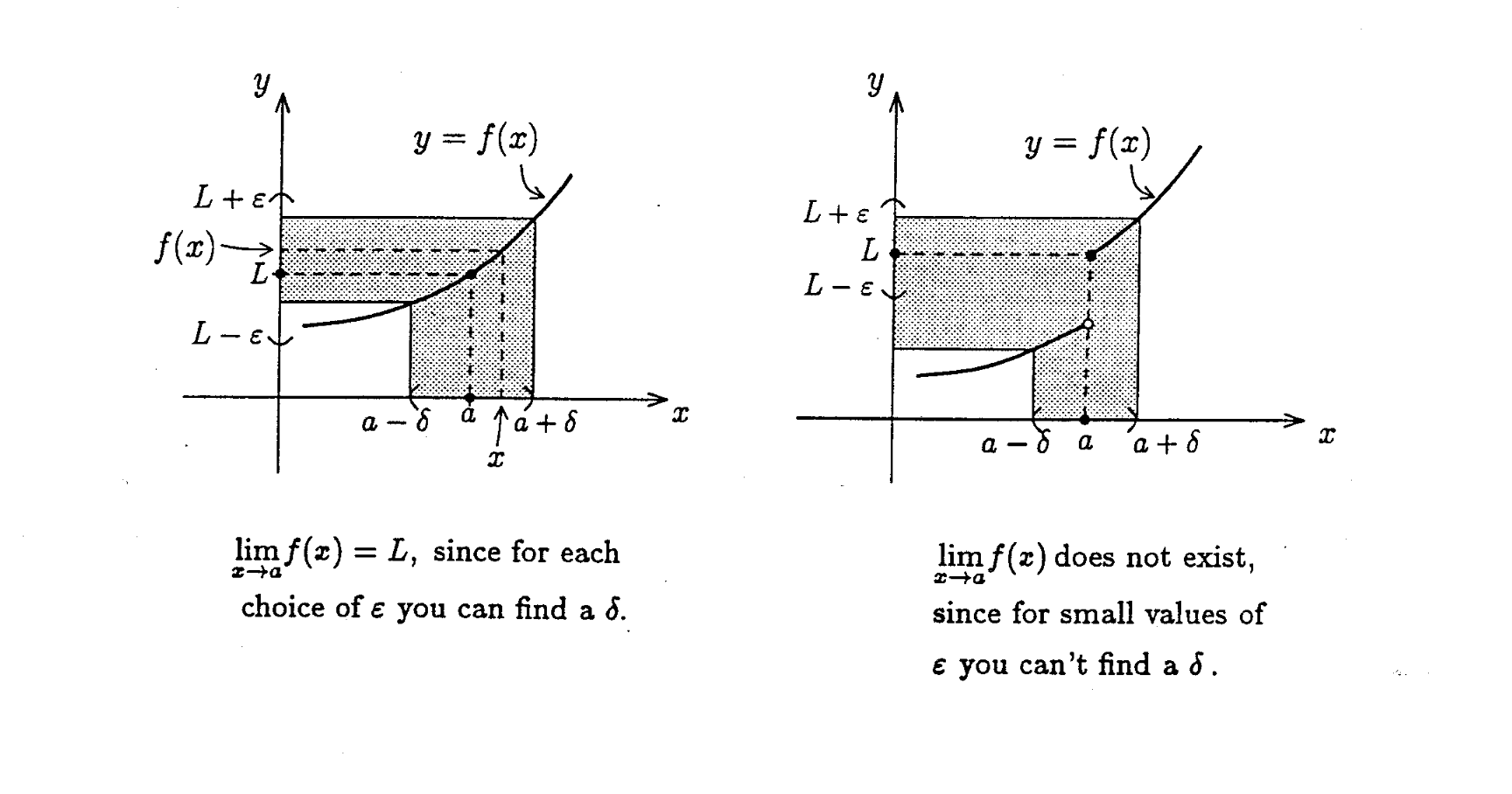
- To prove a limit exists:
- Start with the
, then try to get to - the
implies that
- the
- Start with the
- When you get two values for
(one on either side of ), take the smaller one
Single example
Find
We realize
Full proof
Prove that
Show that
Begin by rewriting in terms of
Alternate solution (if it's not a solvable quadratic)
Limits of Multivariable Functions
- For a function with 2 variables
, means that approaches for all possible paths - This means from every direction, the limit goes to
- It is easier to show that a limit doesn't exist by counterexample (choose two directions that approach a different value)
- You can also set
and show that depends on - This works since you're doing like a line so you're approaching from every possible direction
- This doesn't actually prove that the limit exists though (for example, you could do
and it could give a different value)
- You can also set
- Usually proving a limit involves the squeeze theorem, but sometimes is possible with algebra